
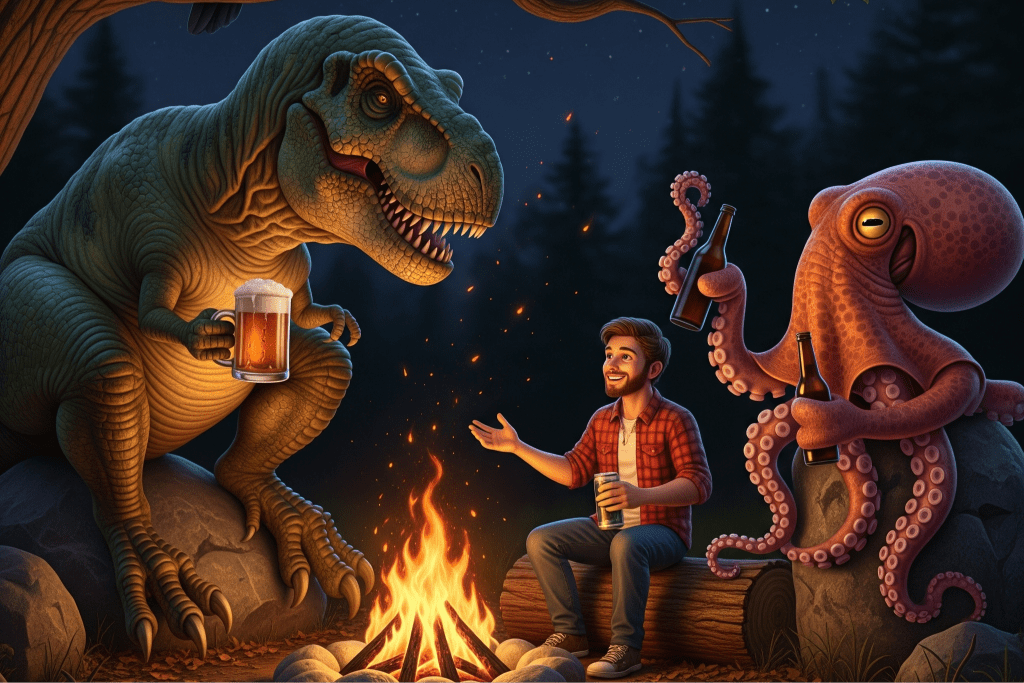
Imagine a single event in earth’s history that changed everything. It has impact not just for one species but for the entire planet. That event was not a meteor or a great flood. It was the moment human ancestor learned to control fire. It did not just warmed their caves – they ignited a revolution that transformed their world and ours. It sculpted our societies, fueled our migrations, and ignited the spark of innovation that led to everything we know today. Let’s explore how fire shaped humanity. Consider the wild idea of dinosaurs wielding it. Imagine a world where humans and dinosaurs shared the stage. Speculate on what might happen if another species masters fire down the line.
The Human Fire Evolution
Around 1.5 millions year ago, early hominids like homo erectus began controlling fire, sparking a revolution that reshape their world. For humans this moment became the defining line between surviving and thriving. Fire did not just changed how human lived; it redefined who we would become. It unlocked a new layer of evolution.
- Cooking: Fire made food easier to digest, unlocking more calories and nutrients, fuels brain growth.
- Warmth: Survival in colder climate.
- Protection: Fire kept predators at bay.
- Community: Fire gathered people, sparking stories and shared knowledge.
- Tools and Technology: From hardening spear tips to forging steel, fire fueled human ingenuity and revolution.
It gave us the power to shape our environment. Without fire, we’d still be clever primates, struggling in the wild.
What If Dinosaurs Discovered Fire?
Now imagine:
A clever species of dinosaur, like Troodon with relatively larger brain to body ratio, smart enough to use and control fire. The implications are wild:
Fire could give Troodon a survival edge, to ward of predators or clearing off habitat. They might have developed a social evolution – building, cooking, story telling. Charred spears or controlled burns could mark the start of dinosaur technology. They would have dominance, may be even faster ecological control than human ever had. A fire-wielding dinosaur species could have delayed or even prevented human ascendancy, creating a world where reptilian civilizations ruled. Or a fire-wielding dinosaur civilization might have left behind scorched fossils or primitive structures, rewriting our understanding of prehistory.
Would mammals ever get their chance if fire-wielding dinosaurs ruled?
If early humans (before fire use) and dinosaurs coexisted, who would dominate Earth—humans or dinosaurs?
In real history:
- Non-avian dinosaurs went extinct ~66 million years ago.
- The genus Homo (early humans) evolved only ~2.5 million years ago.
So, humans and dinosaurs never overlapped. But let’s imagine a fictional world where they did.
Early Humans Before Fire Use
Pre-fire humans (like Homo habilis) were:
- Small in number.
- Physically weak compared to large predators.
- Relied on stone tools, scavenging, and basic hunting.
- Lacked fire, so no protection at night, no cooking, no warmth, no defense against big animals.
Dinosaurs
- Dinosaurs dominated ecosystems for over 150 million years.
- Many were giant predators (e.g., T. rex, Allosaurus) or massive herbivores (e.g., Brachiosaurus).
- They had size, strength, and ecological dominance.
Even smaller theropods were fast, strong, and adapted to hunting.
Who will rule?
Dinosaurs would have dominated. Without fire, early humans lacked a crucial defense against massive predators and a way to process food efficiently. Humans would have been a vulnerable prey species. They lived in the shadow of dinosaurs. Dinosaurs would have masters of their environment for millions of years.
Now Stack Humans With Fire That Against Dinosaurs
Now once you bring fire into the equation for human, everything completely changes. Fire becomes the ultimate game-changer in a world where humans and dinosaurs coexist. Even apex predators like Tyrannosaurus rex were powerful — but they couldn’t adapt or innovate like humans.
Humans + Fire = Apex Predator
With fire, even early Homo erectus could:
- Defend against large predators.
- Plan hunts and even trap or scare off dinosaurs.
- Form tribes with complex roles and coordination.
- Outsmart far stronger creatures using terrain, tools, and fire.
With fire, humans become the most dangerous species on Earth — even in a world full of dinosaurs.
But what if in evolutionary history, humans and dinosaurs co-existed with the ability to control fire. Will they compete or coordinate with each other? Will both or any one of the species went extinct? Will there still be any species to tell the tale? Please comments your thought, I will be eager to read.
The Future: Another Species Claims the Flame
What if, millions of years from now, another species masters fire? Imagine an octopus using volcanic embers to cook prey or a crow sparking fires to signal allies. A fire-using species could mirror humanity’s path, building cultures and technologies. Octopuses might create underwater fire-based systems, while crows could develop aerial societies around flame-lit roosts. If humans still exist, a fire-wielding species could be a rival or ally. Would we share our knowledge or see them as threats? Fire could spark conflict or collaboration across species.
The Flame That Changed Everything
For early humans, it wasn’t just survival — it was revolution. It turned us from hunted to hunters, from scattered bands to civilizations. Without it, in a world shared with dinosaurs, we’d be little more than clever snacks hiding in the dark. But with it? We could rival even the fiercest beast — fire in hand, stories on tongue, and stars in our eyes.
Imagine a campfire under a starlit sky, where a human, a Troodon, and an octopus sit together, sharing a strange but wondrous moment. The human brings tales of cities and stars, the Troodon recounts a world of ancient forests lit by flame, and the octopus offers a brew fermented from sea fruits—a tangy, briny beer from the ocean’s depths. Would you have accepted invitation to such party, considering you may become an appetizers for the Troodon?
 PRADOSH
Leave a comment